


A Danish cross-sector Industrial Research Program turning urgency and ambitions into practice. Funded by Innovation Fund Denmark and Realdania. Facilitated by BLOXHUB, the Nordic Hub for Sustainable Urbanization in Copenhagen, Denmark.
Why?
The time for a regenerative transformation is now. We have inherited a built environment that is fueled and raised by finite and rapidly declining energy and scarce material sources, while driving us furthertowards climate breakdown and ecological collapse.
Rising inequality and lack of affordable housing are tearing at our social fabrics, mobility, and sense of belonging. The built environment urgently needs a distributive and regenerative systemic retrofit thatpromotes human flourishing through sufficiency strategies on a thriving planet. Our shared compass is the Doughnut for Urban Development and Reduction Roadmap.
How?
The construction sector today is caught in a trap: low margins, fragmented value chains, project-by-project risk management, short-term investments, and incentives that reward the repetition of existingsolutions – without regard to ecological impact.
With REGEN, we aim to build the bridge between what science tells us we should do, what we already know we could do, and what changes would allow the innovative and creative capacity of our systems of provisioning to act timely and develop future-proof regenerative praxes and value chains.
REGEN supports applied science in regenerative design, architecture, planning, policy, and business models in the built environment through embedded research (Industrial PhDs and postdocs) that workswith companies and academic supervisors, bridges science and companies, and strengthens pioneering people and projects.
What?
REGEN is designed as a systemic learning network, with a transformative agenda:
- We embed research in real-world constraints (technical, organizational, regulatory, economic)
- Connect disciplines and projects through shared learning, synthesis, and feedback
- Reduce friction to adoption: make new choices clearer, safer, and easier to repeat
- Produce practice-relevant outputs: methods, evidence, tools, publications, and events
We make impacts visible and accountable, to measure, trace, assess and prioritize, through biodiversity/ecosystem impact measurement beyond carbon, Life-cycle + supply-chain tracing, Ecosystem services assessment/mapping/valuation with the purpose of turning unknown impacts into evidence-based decision-making tools.
We turn concepts of regeneration into a usable design and planning practice: translate, frame, design and test in place. Regenerative landscape design frameworks, typologies, and place-basedstrategies. Participation and co-design to ground methods in real landscapes and communities.
We de-risk and scale biogenic construction and renovation solutions by standardizing, industrializing, proving performance, and replicating through responsible scaling of biogenic materials, fire-risktesting, circular refurbishment platforms, and capability building. Design for disassembly demonstrators in industrialized construction. Making new solutions competitive under increasing real-worldconstraints.
We change the rules of the game: procurement, governance, and business model innovation. Incentivize, finance, and organize, through procurement tools and decision-support, municipal clients, public procurement, governance for sufficiency, retrofit-first, absolute sustainability targets, space sufficiency strategies, and demand reduction. Shift incentives, economic and organizational logic, so regenerative choices become default.
Network structure — researchers, companies and universities
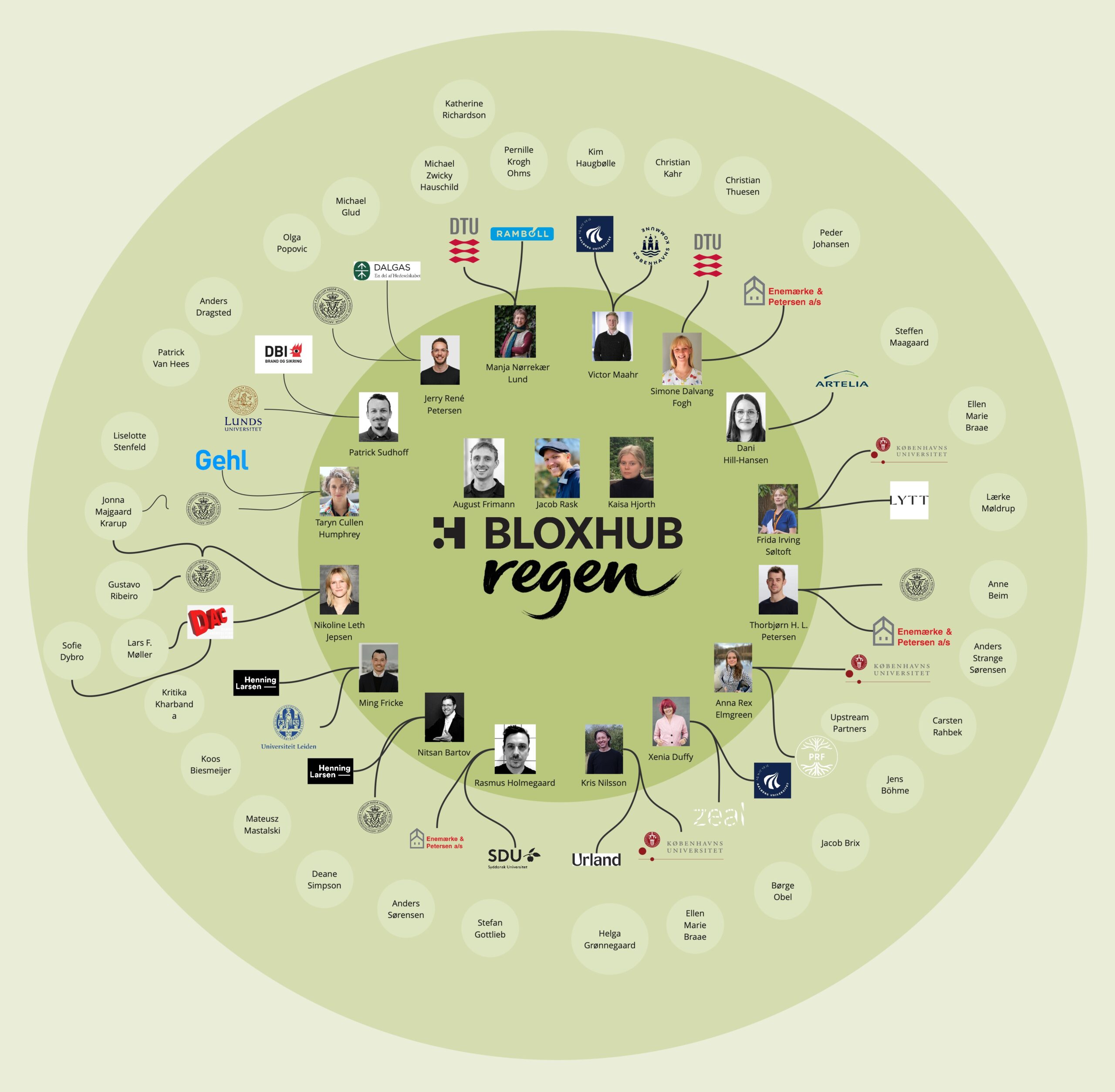
Layer 1 — Core research community (Industrial PhDs & postdocs): Depth of knowledge, cross-disciplinary dialogues, analysis, concepts, cases, individual and collective research communication. Team sessions, writing groups, expert talks, shared platform.
Layer 2 — Bridge to practice (companies + researchers + supervisors): Applied science, translating research in different ways to company and industry perspectives, research as an innovation tool, organizational learning and change. Company visits, co-hosted activities, sector events.
Layer 3 — Long-term community (alumni + early-career researchers): Science talks and meetups beyond single projects. Presenting and discussing new projects, project ideas and concepts relating to applied science in the built environment.
Follow the work
The dedicated REGEN website is the place for everything related to REGEN: the work and its insights, the researchers, and the events.
We are building as we go, so we are adding more insights, researcher bios, and events.